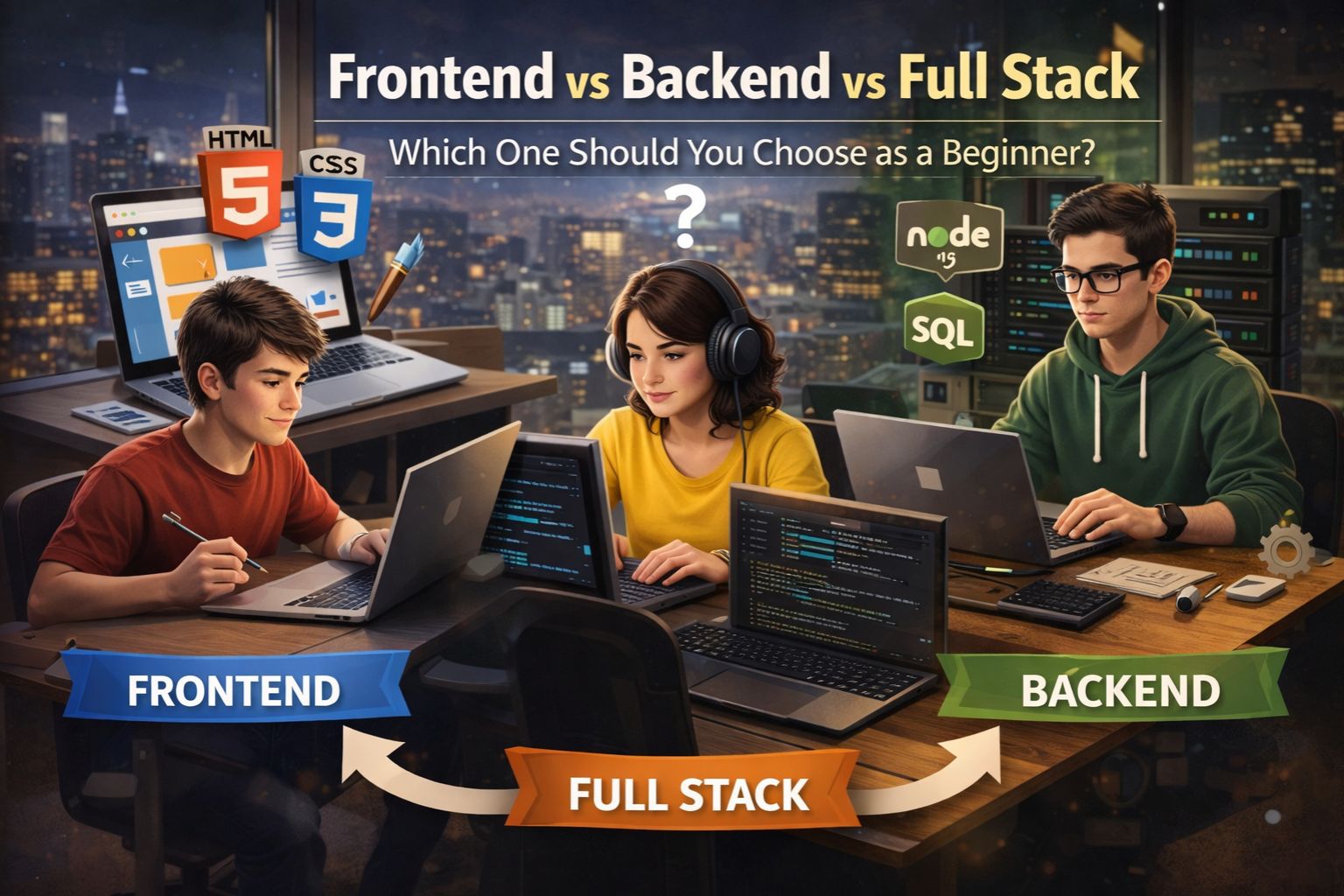
If you are starting your journey in web development, one of the first questions you will face is:
Should I learn frontend, backend, or full stack?
Most beginners get confused here and either delay starting or try to learn everything at once—which leads to frustration.
The truth is simple:
You don’t need to learn everything at once. You need to choose the right starting point.
This guide will help you clearly understand the difference between frontend, backend, and full stack—and how to choose the best path based on your goals.
What is Web Development?
Every website or application has two main parts:
- what users see → frontend
- what works behind the scenes → backend
When both are combined, it becomes a full stack system.
Web Development Starter Course
Frontend Development (User Interface Side)
Frontend is everything you see on a website.
Examples:
- buttons
- layouts
- colors
- forms
- animations
Technologies:
- HTML
- CSS
- JavaScript
What frontend developers do:
- design user interfaces
- make websites responsive
- improve user experience
👉 If you enjoy design, visuals, and interactive elements, frontend is a strong starting point.
Backend Development (Server Side Logic)
Backend is everything that happens behind the scenes.
Examples:
- login systems
- database handling
- APIs
- server logic
Technologies:
- Python / Node.js
- databases (MySQL, MongoDB)
What backend developers do:
- handle data
- manage servers
- build application logic
👉 If you enjoy logic, problem-solving, and system building, backend is a better fit.
Full Stack Development (Combination of Both)
Full stack means working on both frontend and backend.
What full stack developers do:
- build complete applications
- handle UI + server + database
- manage end-to-end systems
👉 This is the most flexible role but requires learning both sides.
Key Differences (Quick Comparison)
Which One Should You Choose as a Beginner?
Here is the practical answer:
Choose Frontend if:
- you are completely new
- you want quick visible results
- you enjoy design and layouts
👉 Best starting point for most beginners.
Choose Backend if:
- you already understand basics
- you enjoy logic more than design
- you want to build systems
Choose Full Stack if:
- you want complete control
- you are ready to learn step-by-step
- you want job + freelance flexibility
👉 But start with frontend first, then move to backend.
Recommended Learning Path (Best Strategy)
Do not start randomly. Follow this:
Frontend → Backend Basics → Full Stack Projects → Deployment
Step-by-step:
- learn HTML, CSS, JavaScript
- build simple websites
- learn backend basics
- connect frontend + backend
- deploy projects
👉 This is the safest and fastest path.
Real-World Insight (Important)
Companies don’t hire based on “frontend” or “backend” labels alone.
They look for:
- ability to build projects
- understanding of workflows
- problem-solving skills
👉 That’s why full stack understanding gives you an advantage.
AI Tools Course (productivity boost angle)
Common Mistakes Beginners Make
Avoid these:
- trying to learn everything at once
- skipping fundamentals
- not building projects
- watching tutorials without practice
- switching paths too often
Final Recommendation
If you are just starting:
👉 Start with frontend
👉 move to backend basics
👉 then become full stack
This approach gives you:
- confidence
- clarity
- real project experience
Final Thoughts
The goal is not to choose a label. The goal is to build real skills.
Frontend, backend, and full stack are not competitors—they are parts of one system.
Start small, stay consistent, and build projects.
That’s how real developers grow.