

Introduction
Artificial Intelligence is evolving rapidly, and one of the most important emerging concepts is Agentic AI.
This is not just a new technical term. It represents a fundamental shift in how AI is used in real-world applications.
Until recently, AI tools were primarily used to generate responses based on user input. However, Agentic AI introduces a more advanced approach, where systems are capable of planning, executing, and completing entire workflows.
In simple terms, AI is moving from being a support tool to becoming an execution system.
Why Agentic AI Matters in 2026
The expectations from students and professionals are changing.
Organizations are no longer looking for individuals who can only use AI tools. Instead, they are looking for people who can:
- design workflows
- automate repetitive tasks
- improve productivity using AI systems
- integrate AI into real-world problem solving
This shift makes Agentic AI a critical skill for future-ready careers.
Students who understand how to apply AI practically will have a clear competitive advantage in internships, freelancing, and job opportunities.
What is Agentic AI?
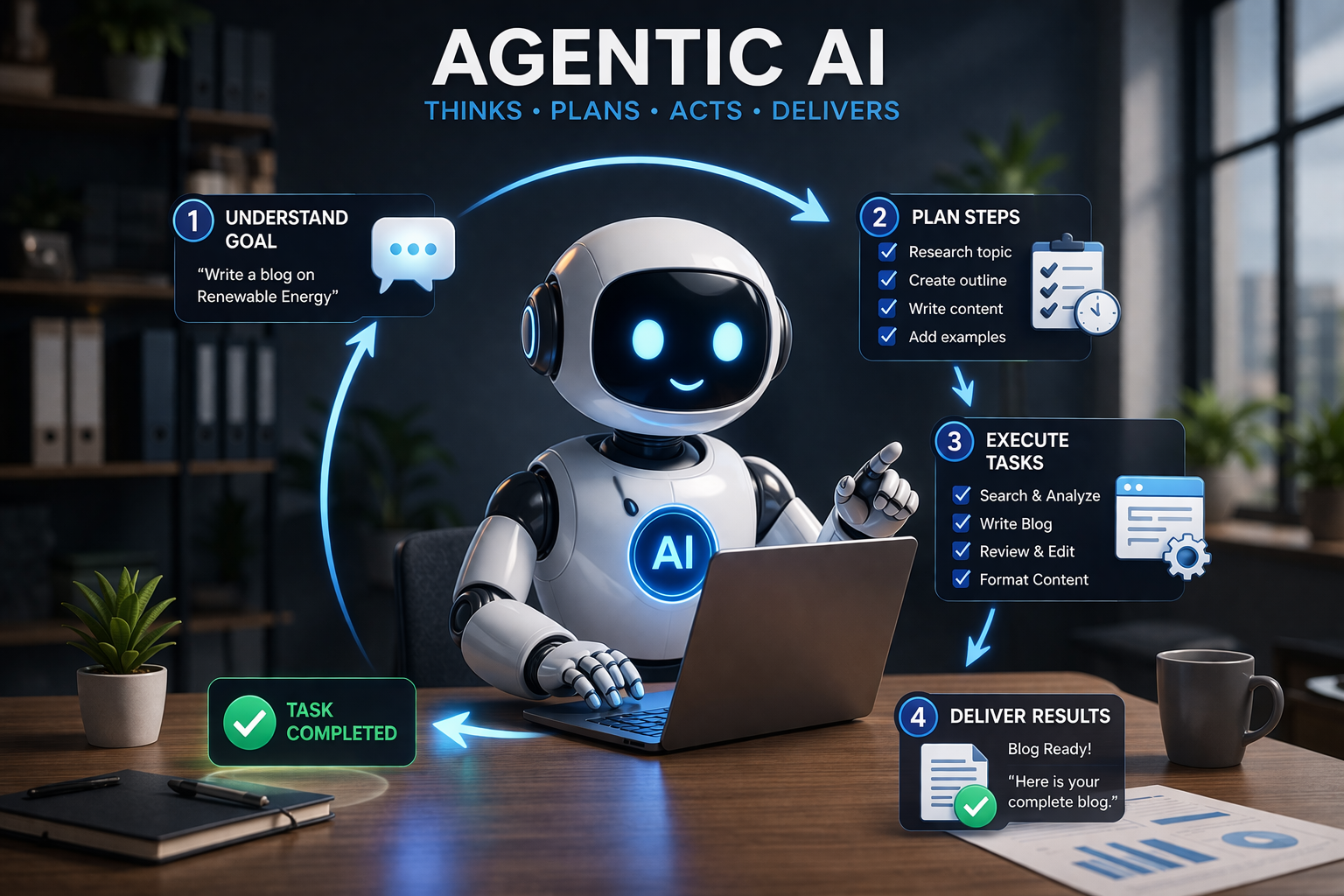
Agentic AI refers to systems that can:
- understand a defined goal
- break that goal into structured steps
- execute each step systematically
Example
Traditional AI:
A user asks, “Write a blog about AI,” and the system generates a response.
Agentic AI:
The system performs:
- topic research
- content structuring
- writing
- optimization
- refinement
This demonstrates the key difference:
Agentic AI completes workflows, not just tasks.

Traditional AI vs Agentic AI
| Feature | Traditional AI | Agentic AI |
|---|---|---|
| Functionality | Single-task execution | Multi-step workflow execution |
| Output | Isolated response | Complete result |
| Control | Fully manual | Semi-autonomous |
| Use Case | Assistance | End-to-end execution |
Conclusion:
Traditional AI acts as a tool, while Agentic AI functions as an intelligent system.

Real-World Use Cases of Agentic AI
1. Content Creation
Agentic AI can handle the complete content pipeline:
- topic research
- content writing
- editing and formatting
- SEO optimization
This significantly reduces time and effort while maintaining consistency.
2. Software Development
In development workflows, Agentic AI can assist with:
- code generation
- debugging
- documentation
- testing support
This allows developers to focus more on problem-solving rather than repetitive tasks.
3. Freelancing Workflows
Freelancers can use Agentic AI for:
- client research
- proposal drafting
- project execution
- reporting
This enables individuals to manage multiple clients efficiently.
4. Data Analytics
In analytics, Agentic AI can support:
- data cleaning
- pattern identification
- insight generation
- report creation
This makes data-driven decision-making faster and more accessible.
Why Students Should Learn Agentic AI
The traditional learning approach often focuses on theory and isolated skills.
However, modern career growth depends on:
- applying skills in real scenarios
- building projects efficiently
- delivering outcomes
Agentic AI enhances all three areas.
Students who combine technical skills with AI workflows can:
- build projects faster
- improve productivity
- create stronger portfolios
- explore early earning opportunities
Skills Required to Get Started
You do not need advanced expertise to begin with Agentic AI.
Start with the following foundational skills:
- understanding AI tools (such as ChatGPT, Gemini)
- basic prompt structuring
- workflow thinking
- problem-solving mindset
These fundamentals are sufficient to begin practical implementation.
Beginner Roadmap to Learn Agentic AI
Step 1: Learn Core AI Tools
Understand how modern AI tools function and where they can be applied.
Step 2: Practice Structured Prompting
Move beyond basic queries and learn how to guide AI effectively.
Step 3: Build Simple Workflows
Combine multiple steps such as research, creation, and refinement.
Step 4: Develop Mini Projects
Examples:
- blog generation system
- presentation builder
- automated content workflow
Step 5: Create a Portfolio
Document and showcase your projects to demonstrate practical skills.
Common Mistakes to Avoid
Many beginners limit their growth due to incorrect usage of AI.
Avoid the following:
- treating AI as a search engine
- copying outputs without understanding
- not building structured workflows
- focusing only on tools instead of thinking
The correct approach is to treat AI as a system-building enabler, not just a shortcut.
The Future of Agentic AI
Agentic AI is already being integrated into:
- startups
- enterprise workflows
- freelancing ecosystems
- digital product development
Over the next few years, the key differentiator will not be whether someone knows AI, but how effectively they use AI within their workflows.
Conclusion
Agentic AI represents a shift from passive assistance to active execution.
It enables individuals to:
- automate workflows
- improve productivity
- build real-world projects faster
For students and early professionals, this is a powerful opportunity to accelerate learning and career growth.
Quick Summary
- Agentic AI enables multi-step workflow execution
- it goes beyond traditional AI capabilities
- it is widely applicable across industries
- it provides a strong advantage for students and professionals
Final Recommendation
Start with simple use cases.
Focus on building small workflows.
Gradually expand into more complex systems.
Consistent practice will lead to real progress.